
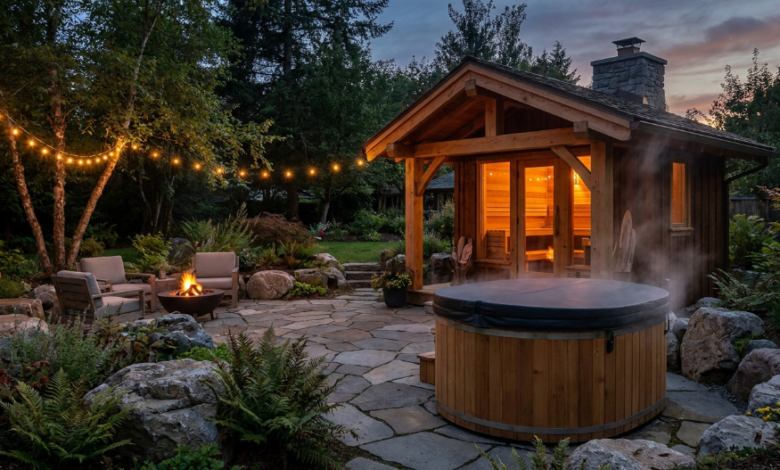
For two people using a home sauna most days of the week, the target is an electric heater in the 6 to 8 kW range paired with 150 to 200 pounds of basalt stones, sized to a room of roughly 250 to 350 cubic feet and wired to a dedicated 240 volt circuit. That combination reaches 170 to 190 degrees Fahrenheit in 30 to 45 minutes and holds steady through back to back sessions without tripping a breaker or leaving the room underheated on a cold night.
How much heater capacity does daily two-person use actually need?
Heater sizing starts with cubic footage, not square footage. Multiply the room’s length, width, and height, then match that number against the manufacturer’s kW chart. A well-insulated cedar room with a solid door needs roughly 1 kW per 45 to 50 cubic feet. A room with a glass door, a glass wall, or an uninsulated exterior wall loses heat faster, so most manufacturers add 50 percent or more to the required kW for every glass panel. A 4 by 6 foot room with a 7 foot ceiling and one glass door comes out to about 168 cubic feet before the glass adjustment, which usually lands the right heater in the 6 kW range once the correction is applied. Daily use adds one more variable beyond a single weekend session: the heater has to recover fast between back to back sittings, so buyers running it every day generally do better sizing to the upper end of the manufacturer’s range rather than the minimum listed for the room.
Electric resistance with stones, or something else?
Two heater families dominate home saunas. Electric resistance heaters with a stone basket are the traditional setup, producing dry heat plus bursts of steam (loyly) when water hits the rocks. Infrared panel systems are a separate category that heats the body directly through carbon or ceramic panels rather than heating room air and stone mass, and they run on far lower wattage as a result. For anyone who wants the classic hot room, stone, and steam experience daily, a stone heater is the right fit, and it is the type this sizing math applies to. Wood-fired heaters are a third option common in off-grid cabins but they are a poor match for daily indoor use because of the fuel handling and the longer preheat.
Which stones hold up to daily steam cycles?
Basalt is the standard choice: dense, low-porosity volcanic rock that resists cracking better than softer stone under repeated heating and water contact. Peridotite, sometimes sold as olivine, runs a close second and is favored in some higher-end kits for slightly better heat retention. Either way, load the basket to the weight the heater manufacturer specifies, usually 150 to 200 pounds for a 6 to 8 kW unit, and never substitute river rock or landscaping stone, which can trap moisture and shatter. With daily use, plan to sort out cracked stones every few months and do a full replacement around the 12 to 18 month mark.
Wiring and clearance rules that matter for a daily-use unit
A 6 to 8 kW heater draws roughly 25 to 33 amps at 240V, which means a dedicated circuit and breaker sized to the specific model’s nameplate rating, not a shared circuit with other loads. Most jurisdictions require this wiring to be pulled or inspected by a licensed electrician, and the heater has to sit on a listed, non-combustible floor pad with the manufacturer’s minimum clearance to walls, benches, and any wood guard rail, typically a few inches depending on the model. Skipping the guard rail or crowding the heater against a bench is the most common code violation seen in home installs, and it is also a real burn risk once a family is using the room every day rather than occasionally.
Retailers that specialize in sauna equipment, including SweatDecks, carry two-person-sized heaters bundled with a matched, pre-weighed stone kit so the wattage and stone load are already paired correctly. see the full lineup to compare kW ratings and stone weights side by side before settling on a breaker size and floor pad.
Why the setup cost is worth it for daily users
Getting the kW rating, stone load, and wiring right is more work than picking whatever heater ships fastest, but daily sauna use is exactly the pattern researchers have studied most closely. Cohort research out of Finland has linked frequent sauna bathing with lower cardiovascular mortality risk, and a Mayo Clinic Proceedings review summarizing that evidence base notes the association strengthens with session frequency, not just heat exposure on its own. That is association data, not proof that a sauna session prevents any specific outcome, and it says nothing about heater brand or wattage. What it does support is that a setup built to survive daily use without shortcuts, correct sizing, real stone, and a properly wired circuit, is the setup most likely to still be in daily rotation a year from now instead of sitting unused after a breaker trip or a burned out element.
A short sizing checklist before you buy
Measure the finished room in cubic feet, not the floor plan on paper. Note every glass panel and apply the manufacturer’s derate for it. Confirm the electrical panel has room for a new dedicated 240V circuit at the amperage the heater needs. Check that the layout leaves the code required clearance around the heater location on every side. Decide on basalt or peridotite before ordering, since baskets are sized differently for each stone type. Ask whether the digital control includes a timer, since a unit running daily benefits from an auto shutoff more than one used only on weekends.
Frequently Asked Questions
What size heater do I need for a two-person sauna used most days?
For a well-insulated cedar room between 250 and 350 cubic feet, a 6 to 8 kW electric heater is the usual match. Rooms with a glass door or an outside wall need extra capacity because the glass loses heat faster than solid wood.
Can a sauna heater run on a standard 120V outlet?
Only small units under about 1.5 kW are built for a 120V plug-in circuit, and those are usually too weak for daily two-person use in a full-size cabin. Anything in the 6 to 8 kW range needs a dedicated 240V circuit sized to the heater’s amperage draw.
How often do sauna stones need replacing with daily use?
Daily steam cycles crack stones faster than occasional use. Basalt typically lasts 12 to 18 months under daily loyly before enough stones split to hurt heat retention, and a visual check every few months catches the problem early.
How long does a 6 to 8 kW heater take to reach full temperature?
Expect 30 to 45 minutes to climb from room temperature to 170 to 190 degrees Fahrenheit, depending on insulation, room volume, and how much stone mass the heater is carrying.
Do infrared panels need the same sizing math as a stone heater?
No. Infrared panels heat the body directly rather than the air and stones, so they run on far lower wattage and skip the kW-to-cubic-foot calculation entirely. They belong to a different category of unit.
References
- “Cardiovascular and Other Health Benefits of Sauna Bathing: A Review of the Evidence.” Mayo Clinic Proceedings, 2018. https://pubmed.ncbi.nlm.nih.gov/30077204/
- “Clinical Effects of Regular Dry Sauna Bathing: A Systematic Review.” Evidence-Based Complementary and Alternative Medicine, 2018. https://pubmed.ncbi.nlm.nih.gov/29849692/
- “Benefits and risks of sauna bathing.” The American Journal of Medicine, 2001. https://pubmed.ncbi.nlm.nih.gov/11165553/


